
 Select Photos
How to Use AI to Design a Minimalist Garden
Using Artificial Intelligence (AI) to design a Minimalist Garden is a brilliant way to blend modern technology with timeless aesthetics. This approach allows you to optimize the balance between visual beauty and practical functionality.Here is a detailed guide on how to use AI as your "digital landscape architect" to realize your minimalist sanctuary.
1. Understanding Your Three Pillars:
To get the most out of AI, you must provide it with a "brief" based on these three pillars:
- Pillar 1 (Minimalist Aesthetics): Focused on the "Less is more" philosophy. Think clean lines, neutral color palettes (gray, white, green), and natural materials like stone, concrete, and wood.
- Pillar 2 (AI Technology): Utilizing Large Language Models (like Gemini or ChatGPT) for conceptualizing and Image Generation models (like Midjourney or Adobe Firefly) for visualization.
- Pillar 3 (Lifestyle & Maintenance): A minimalist garden must be easy to care for, creating a space for relaxation and silence.
2. The AI-Driven Design Process
Step 1: Conceptualizing & Plant Selection (Language AI):
Use AI to research plants that fit your local climate while maintaining a "minimalist" look.
Sample Prompt: "I want to design a minimalist garden in [Your Location]. Suggest 5 drought-tolerant plants with strong architectural shapes (e.g., snake plants, succulents, or Japanese Maples) that are low-maintenance."
Step 2: Visualizing the Space (Image AI)
This is where AI shines. You can use tools like Midjourney or DALL-E to "see" your garden before spending a penny.
Pro Tips for Prompts:
- Keywords: Zen garden, Modern minimalism, Geometric layout, Low maintenance, Neutral color palette, High-end landscaping.
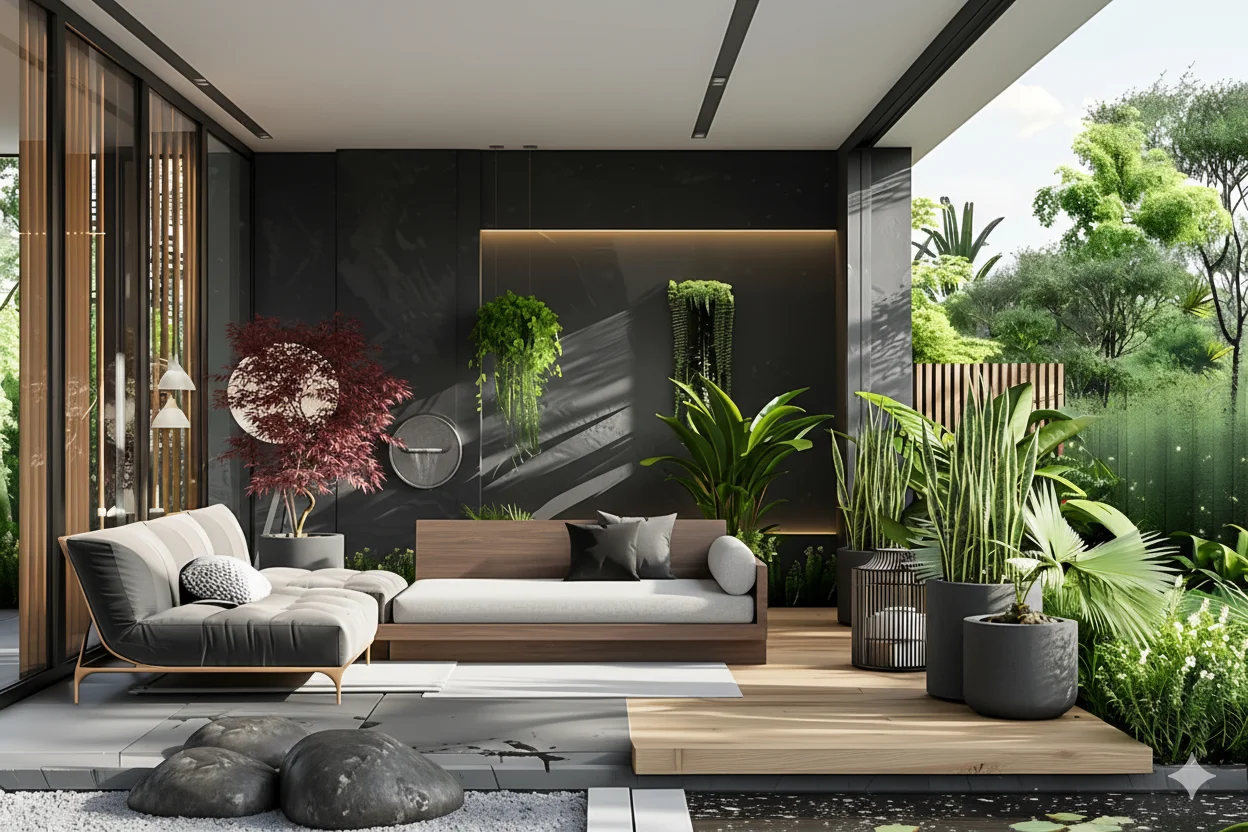
- Example: "A high-quality 3D render of a small minimalist backyard, featuring gray large-format stone pavers, a single architectural tree in a black planter, and soft ambient lighting at night, cinematic style."
Step 3: Optimizing the Layout
If you have a photo of your current yard, you can upload it to AI-powered editing tools (like Adobe Firefly’s Generative Fill) to "test" different furniture or paving options in real-time.
3. "Golden Rules" AI Will Help You Implement
When asking for AI advice, stick to these principles to ensure a true minimalist result:
- Element: Layout
+ Minimalist Principle: Use geometric shapes (squares, circles, rectangles).
+ AI Support Role: AI generates symmetrical or balanced asymmetrical layouts.
- Element: Color
+ Minimalist Principle: Limit to a maximum of 3 primary tones.
+ AI Support Role: AI suggests harmonious color palettes for plants and materials.
- Element: Focus
+ Minimalist Principle: Choose only one "hero" element (e.g., one sculpture or one feature tree).
+ AI Support Role: AI lets you swap different focal points in seconds to see what fits.
4. From AI Prompt to Reality
Once you have your ideal AI-generated design:
- Feasibility Check: Show the AI image to a local contractor to discuss soil types and drainage.
- Smart Integration: To complete the "tech ecosystem," install an automated irrigation system based on moisture sensors to satisfy Pillar 3 (Low Maintenance).
#AI #LandscapeDesign #MinimalistGardening #SustainableLandscaping #ArchitecturalPlants #GenerativeDesign
Likes
Comment